

Democritus
Although little is known of his life, quite a lot is known of his physics and philosophy.
Certainly Democritus was not the first to propose an atomic theory. Traces of an atomic theory go back further than this, perhaps to the Pythagorean notion of the regular solids playing a fundamental role in the makeup of the universe. However Democritus produced a much more elaborate and systematic view of the physical world than had any of his predecessors.
Democritus asserted that space, or the void, had an equal right with reality, or Being, to be considered existent. He conceived of the void as a vacuum, an infinite space in which moved an infinite number of atoms that made up Being (i.e. The physical world). These atoms are eternal and invisible; absolutely small, so small that their size cannot be diminished (hence the name atomon, or "indivisible"); absolutely full and incompressible, as they are without pores and entirely fill the space they occupy; and homogeneous, differing only in shape, arrangement, position, and magnitude.
Now with this as a basis to the physical world, Democritus could explain all changes in the world as changes in motion of the atoms, or changes in the way that they were packed together. This was a remarkable theory which attempted to explain the whole of physics based on a small number of ideas and also brought mathematics into a fundamental physical role since the whole of the structure proposed by Democritus was quantitative and subject to mathematical laws.
Another fundamental idea in Democritus's theory is that nature behaves like a machine, it is nothing more than a highly complex mechanism.
Democritus's philosophy contains an early form of the conservation of energy.
In his theory atoms are eternal and so is motion. Democritus explained; "The origin of the universe through atoms moving randomly and colliding to form larger bodies and worlds".
There was no place in his theory for divine intervention. This was not a world which came about through the design or purpose of some supernatural being, but rather it was a world which came about through necessity, that is from the nature of the atoms themselves.
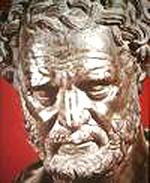
A brief look at one of the original scientific philosophers, Democritus
AlexanderDESIGN
4851 N. Washtenaw Ave., Chicago, IL 60625
773.271.0318
last update 4/14/16